KindLine TECH Deploys Counter-UAV Active Defense System at Zhuhai Gaolan Port Petrochemical Base
Integrated detection-and-spoofing solution secures the Pearl River Delta's largest petrochemical hub
Project Background

Situated at the southern tip of the Pearl River Delta, Zhuhai Gaolan Port boasts the region's largest-tonnage liquid chemical and bulk cargo berths, with natural conditions suitable for constructing 300,000-DWT petrochemical terminals. As the core zone of a national-level economic and technological development area, the Gaolan Port Petrochemical Base has attracted numerous renowned domestic and international oil and gas enterprises, establishing itself as a vital energy and chemical industry cluster in South China.
With the rapid growth of the low-altitude economy, unauthorized drone incursions—commonly referred to as “black flights”—have posed an escalating threat to critical infrastructure including storage tank farms, pipeline corridors, and loading docks. China's Ministry of Public Security standard GA 1551.1-2019, Anti-Terrorism Security Requirements for Petroleum and Petrochemical Systems, explicitly mandates that oil and gas storage facilities equip counter-UAV active defense systems with signal coverage extending over all tank areas. The Gaolan Port Base urgently required a compliant, intelligent, and always-on low-altitude security solution.
Solution Overview
KindLine TECH designed and delivered an integrated detection-and-spoofing counter-UAV active defense system tailored to the Gaolan Port Base's protection requirements. The system employs a two-tier architecture—passive detection and early warning combined with GNSS spoofing countermeasures—to provide 24/7, 360-degree low-altitude security for the base's critical assets.
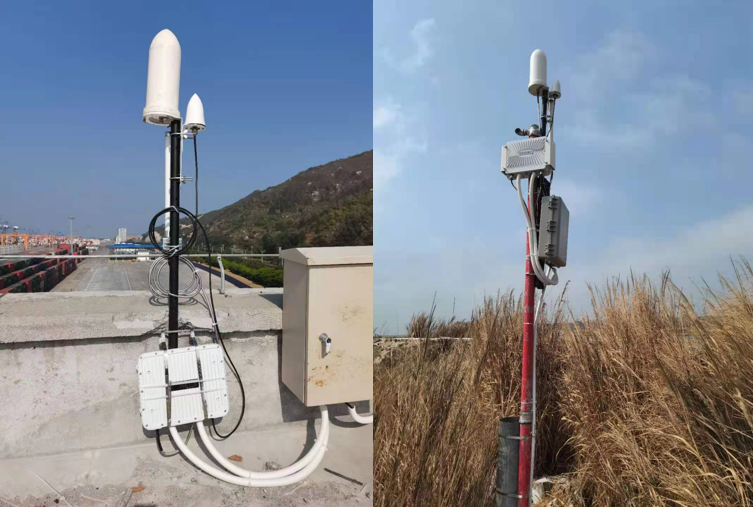
At the detection layer, multiple fixed UAV detection units are deployed across the site. Based on Time Difference of Arrival (TDOA) spectrum analysis, these units passively monitor airspace within a 2–3 km radius without emitting any electromagnetic signals, ensuring zero interference and high concealment. The system can simultaneously detect and identify over 20 drone targets—spanning major brands such as DJI, Autel, and Kebeitian, as well as custom-built FPV racers—with an average false alarm rate below one per day. When four or more units are networked, the system achieves real-time precision tracking with positioning accuracy better than 10 meters.
At the countermeasure layer, GNSS spoofing devices radiate regenerated satellite navigation signals (GPS L1 / GLONASS L1) at a power not exceeding 10 mW, establishing a low-altitude denial zone with a 500–1,000 m radius. Upon detection of an unauthorized drone entering the alert perimeter, the system automatically triggers audible and visual alarms and activates the spoofing unit for a brief burst, severing the drone's satellite navigation link and forcing it to return to its home point or execute a controlled landing—all without human intervention.
Technical Highlights
First, collateral interference reduced from 24/7 to minutes. Conventional single-spoofing solutions must broadcast continuously, posing a persistent risk to petrochemical plant timing systems. KindLine TECH's integrated approach activates spoofing only upon confirmed target detection, compressing potential interference to mere minutes and fundamentally eliminating impact on production instrumentation.
Second, full-time early warning with complete event traceability. The system supports multi-channel alerting (audible/visual alarms, SMS notifications) and records each intruding drone's brand, model, unique serial number, flight trajectory, and pilot location. All data is available for playback and forensic review, providing comprehensive situational awareness for security personnel.
Third, full compliance with national counter-terrorism standards. Signal emission power remains at or below 10 mW in accordance with GB 8702-2014 (Electromagnetic Environment Control Limits). Fixed units operate autonomously 24 hours a day, 7 days a week, and carry explosion-proof certificates issued by the National Center for Quality Supervision and Testing of Explosion-Proof Electrical Products, meeting deployment requirements for hazardous petrochemical environments.
Project Outcomes
Since deployment, the Gaolan Port Petrochemical Base has achieved round-the-clock intelligent management of low-altitude airspace over its critical protection zones, effectively closing the gap in active counter-UAV defense. The system's stable operation and low false-alarm rate have earned strong recognition from base management, setting a benchmark for low-altitude security construction among petrochemical enterprises across the Pearl River Delta region.


